
Words Follow Power

Words Follow Power
How Language Was Weaponized to Reclassify Conquered Peoples
History is not only written by the victors.
It is classified by them.
Over time, the language used to describe conquered peoples does not disappear—it mutates. Words that once described identity slowly harden into markers of defeat, and eventually into moral judgment. What begins as a neutral descriptor ends as an insult, a stigma, or a justification for exclusion.
This is the central argument explored in the accompanying visual research deck, Words Follow Power, a study of how linguistic drift mirrors political conquest, social demotion, and historical erasure in the British Isles and beyond.
.
The Mutability of Truth
Across generations, history undergoes a quiet transformation.
A people are conquered.
Their autonomy is lost.
Their names remain, but their meanings change.
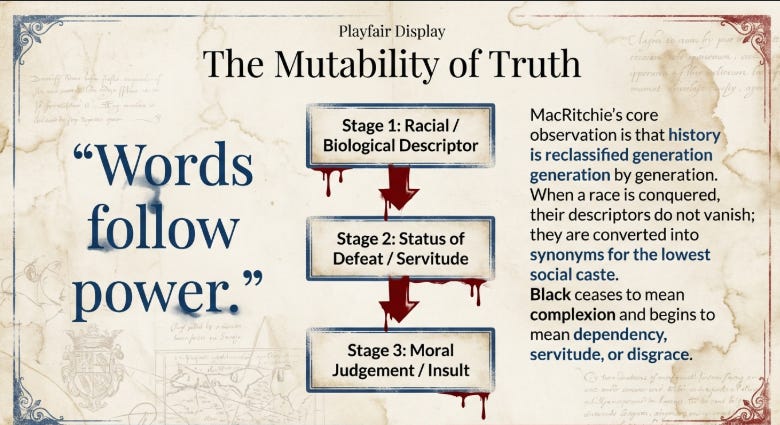
The deck outlines a recurring three-stage pattern visible across medieval and early modern sources:
Stage One: A racial or biological descriptor
Stage Two: A marker of defeat or servitude
Stage Three: A moral insult or social slur
This process explains how descriptors tied to appearance, geography, or ancestry become shorthand for inferiority once power shifts hands. Language does not lead conquest. It follows it.
Color as Political Theory, Not Biology
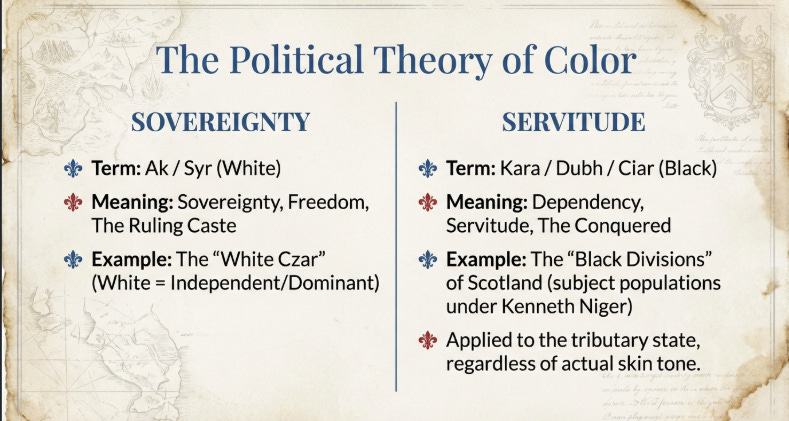
One of the most misunderstood elements of early European terminology is color itself.
In medieval usage, terms translated today as white and black often functioned as political categories, not literal references to skin tone.
“White” signified sovereignty, independence, and dominance.
“Black” signified subjugation, dependency, or tributary status.
These labels were applied to populations regardless of complexion, especially in administrative, legal, and military contexts. Over time, however, the political meaning collapsed into a racial one, while retaining the moral weight of defeat.
When a Word Falls With a People
The deck traces several case studies where words fall in status alongside the people they once described.
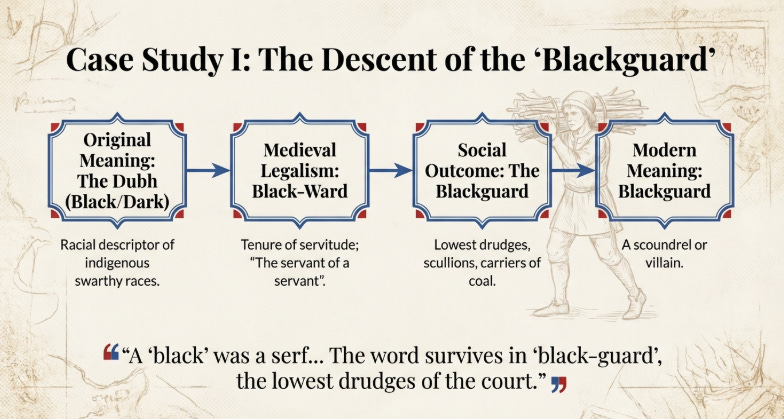
One example is the term “blackguard.” Originally tied to servitude within medieval households, it gradually detached from its social context and became a generic insult—long after the original class system that produced it disappeared.
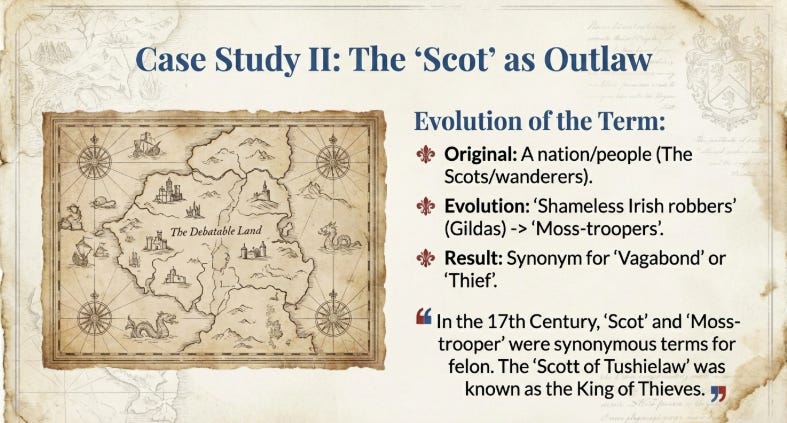
Another is the transformation of “Scot.” Once denoting a people or nation, it later appears in English legal and cultural texts as a synonym for outlaw, thief, or vagrant—particularly during periods of border warfare and internal colonization.
In each case, the pattern is the same:
Identity becomes accusation
Description becomes judgment
Memory becomes stigma
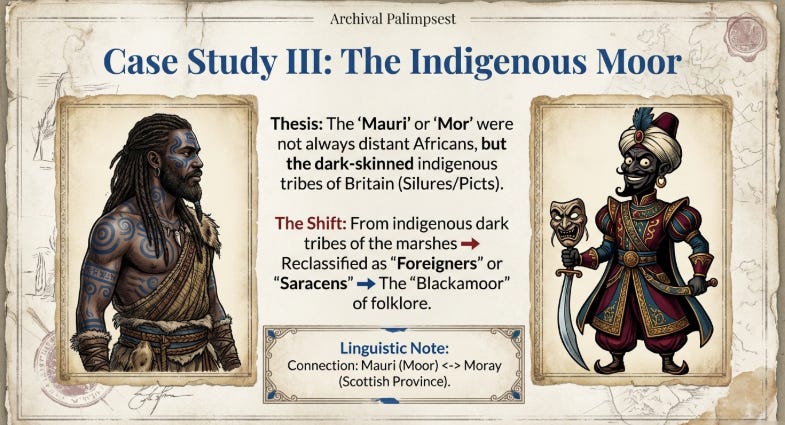
The Indigenous “Moor” and the Myth of Foreignness
One of the most persistent misconceptions in British and European history is that references to “Moors” must always indicate distant Africans or Islamic invaders.
The deck presents an alternative, source-based thesis: that many early references to Mauri, Mor, or Moor describe dark-skinned indigenous populations of Britain itself—particularly marsh-dwelling groups later identified as Silures or Picts.
As conquest progressed, these populations were:
Reclassified as foreigners
Absorbed into folklore
Recast as symbolic villains
Their physical presence faded from record, but their image remained, frozen in art, heraldry, and legend.
Heraldry as Frozen History
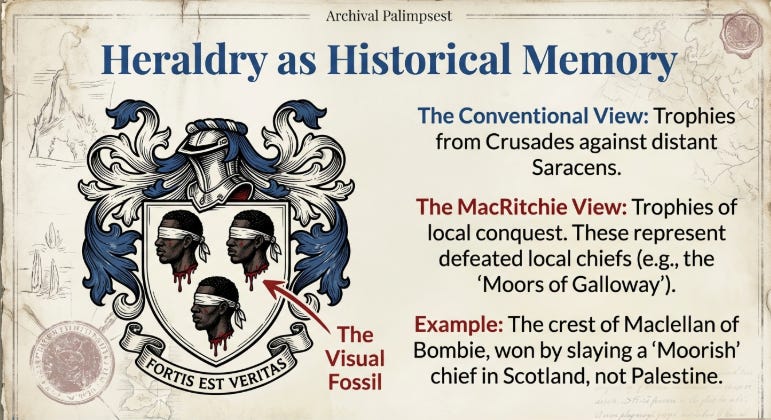
Coats of arms are often explained away as symbolic trophies from distant crusades. But the deck challenges this assumption.
Following the work of David MacRitchie, heraldic “Moor’s heads” are reinterpreted not as exotic souvenirs, but as local memorials of conquest. These images commemorate defeated regional leaders whose names were erased while their likenesses endured.
Heraldry, in this sense, becomes a visual fossil, preserving what written history later obscured.
Criminalizing Custom
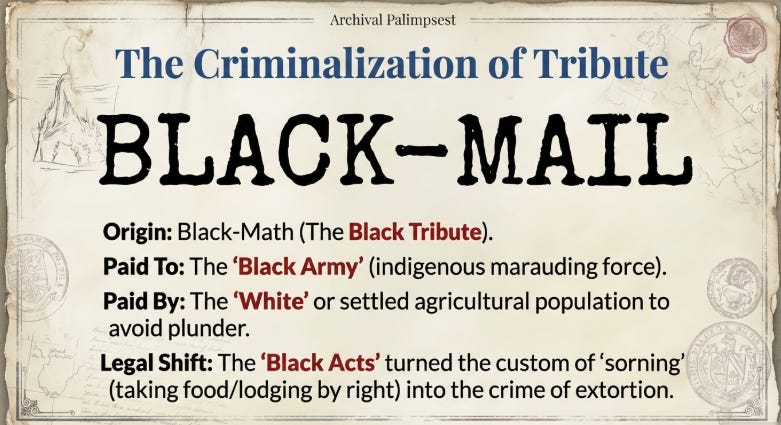
Practices once understood as customary rights,hospitality, tribute, seasonal movement—were later reframed as crimes once political control changed hands.
The term “blackmail,” for example, originated not as extortion, but as a black tribute paid to indigenous forces to avoid conflict. Only after legal restructuring did the practice become criminalized, while the original power imbalance vanished from the narrative.
Geography Remembers What Text Forgets
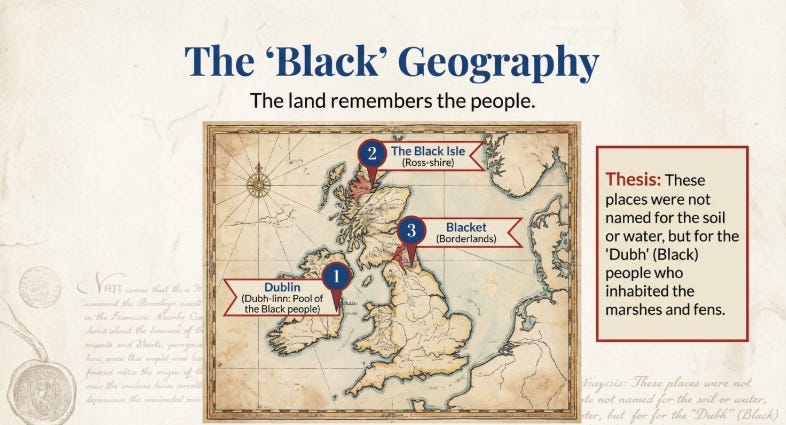
Maps preserve what chronicles often erase.
Place names such as Dublin, Black Isle, and Blackett lands encode memory—not of soil or water, but of people. These names persist even after the populations they described were displaced, reclassified, or absorbed.
The land remembers longer than language allows.
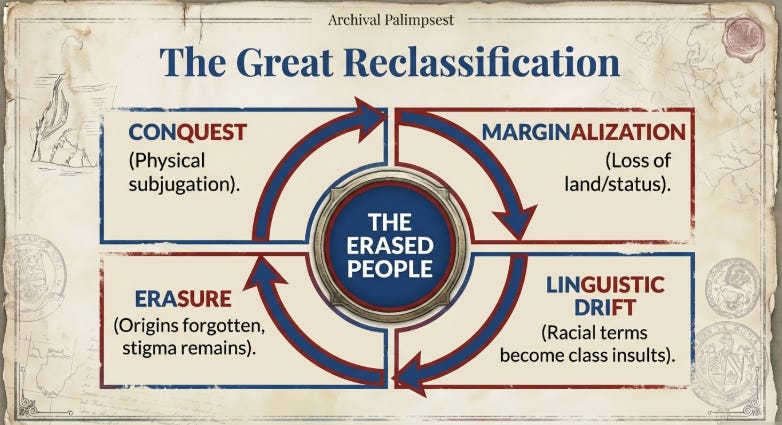
The Great Reclassification
Conquest does not end with land seizure.
It continues through interpretation.
Over generations, the conquered pass through a final cycle:
Physical subjugation
Loss of status
Linguistic drift
Cultural erasure
What remains are words stripped of origin and burdened with judgment—while the people themselves vanish from common memory.
Why This Matters
This research is not about reversing labels or assigning modern identities to the past.
It is about restoring context.
When we decode the language of history, we uncover how power shaped not just borders, but meaning itself. To understand the past honestly, we must learn to read words as artifacts of domination, not neutral descriptors.
History does not lie.
But it does speak the language of its conquerors.
Sources & Methodology
This presentation and article draw primarily on the ethnological and linguistic analyses of David MacRitchie (Ancient and Modern Britons, Vol. I–II) and Boyd Dawkins (Our Earliest Ancestors in Britain), alongside comparative legal, cartographic, and heraldic evidence
.